Mount Pilatus Excursion from Lucerne — Golden Round Trip and 73 Peaks
Among all the mountains of Switzerland, Pilatus holds a special place in the collective imagination. According to medieval legend, the body of Pontius Pilate rests at the bottom of a secret lake on its summit, and fire-breathing dragons once haunted its jagged ridges. Even today, the tormented silhouette of Pilatus dominates Lake Lucerne with a majesty that fully justifies its mythical reputation.
The Golden Round Trip is the classic route for discovering this legendary mountain, and it fully deserves its golden epithet. The adventure begins on the quays of Lucerne, where you board a paddle steamer — those elegant vessels that have plied Lake Lucerne since the 19th century. The crossing to Alpnachstad takes about an hour and a half: time enough to absorb the lakeside scenery, observe fishing villages clinging to the shores, and watch the silhouette of Pilatus grow sharper as you approach.
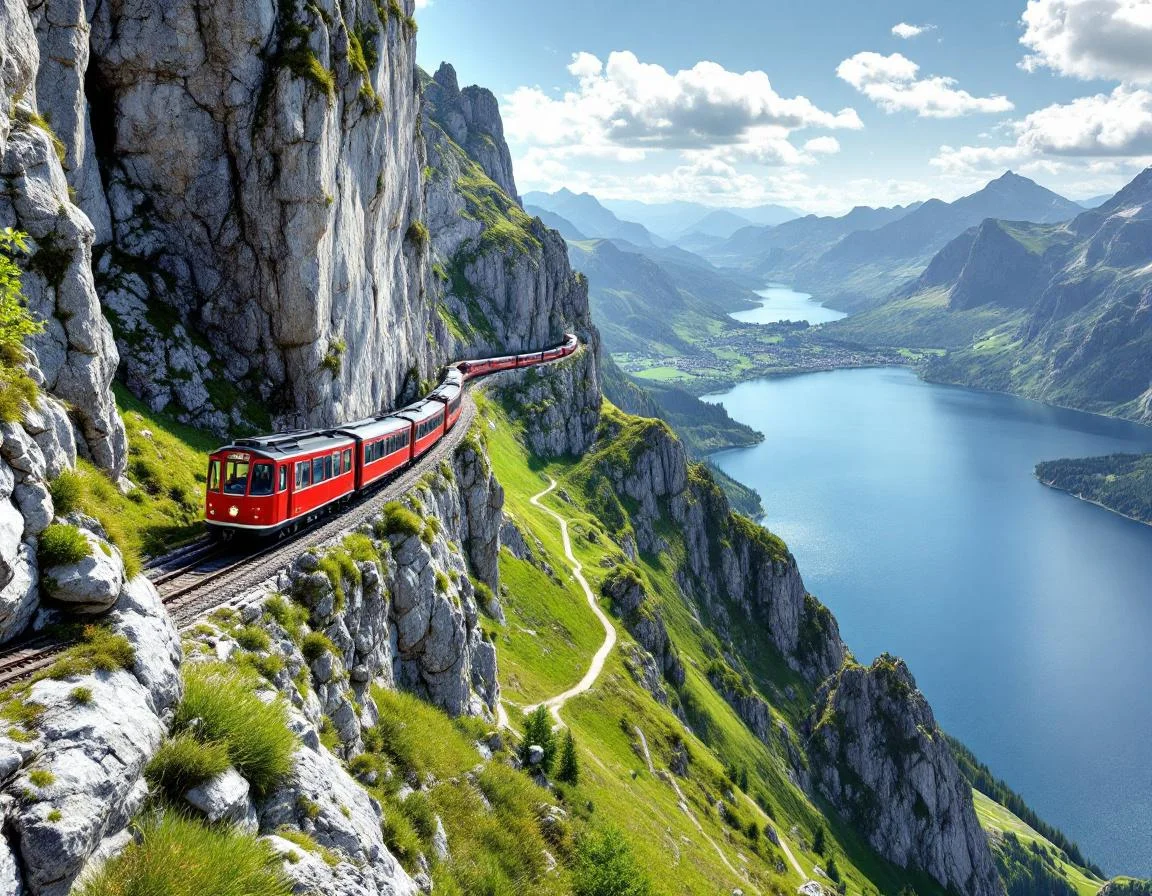
The steepest cogwheel railway in the world
At Alpnachstad, the main attraction awaits: the Pilatus Railway, the steepest cogwheel railway in the world, with gradients reaching 48 degrees. Inaugurated in 1889, this railway line is a masterpiece of Victorian audacity. For forty minutes, the bright red carriages cling to the rock face with metronomic precision, revealing breathtaking new landscapes at every bend. Beech and spruce forests gradually give way to Alpine meadows and then to lichen-covered rocky escarpments.
At the summit, at 2,132 metres, the panorama is strikingly vast. On clear days — which are frequent at these heights — you can distinguish up to 73 Alpine peaks, from Mont Blanc to the Fribourg Alps. Lake Lucerne stretches below like a living postcard, its blue waters dotted with white boats. Take time to explore the various terraces and trails around the summit, each offering a different angle on this exceptional panorama.
At the summit of Pilatus — panorama and legends
The descent is made in two stages by panoramic gondolas and chairlifts to Kriens, on the outskirts of Lucerne. It is a gentle, luminous way to return to valley level, enjoying a final series of views over the lake and surrounding peaks. The Golden Round Trip is far more than an excursion: it is a travel narrative in itself, a perfect composition of water, iron and stone.
Highlights
- Steamboat cruise on Lake Lucerne from Lucerne
- Pilatus Railway — the steepest cogwheel railway in the world (48° gradient)
- Panorama of 73 Alpine peaks from the summit of Pilatus
- Descent by panoramic gondolas and chairlifts to Kriens
- A circular route combining three legendary modes of transport
Detailed Programme
Departure by boat from Lucerne
Board the paddle steamer from the Lucerne pier. Panoramic crossing of Lake Lucerne with commentary on the villages, castles and local legends.
Arrival at Alpnachstad
Disembark and access the cogwheel railway station. The guide explains the history and exceptional engineering of the Pilatus Railway before the ascent.
Ascent by cogwheel railway
Spectacular climb aboard the red train on the steepest gradient in the world. Forty minutes of pure Alpine vertigo, between rock walls and suspended meadows.
Exploring the summit
Free time at the summit to enjoy the panorama of 73 Alpine peaks, walk the marked trails and dine at the panorama restaurant. Stunning views of Lake Lucerne.
Descent by gondolas
Descent by panoramic gondolas to Fräkmüntegg, then by chairlift to Kriens. Each stage reveals a new tableau of the countryside and the lake.
Return to Lucerne
Panoramic bus from Kriens to central Lucerne. End of excursion on the city quays, with the option to extend your visit to the city.
Included in the tour
- Bus transport from Lucerne to the quays
- Steamboat ticket (Lucerne — Alpnachstad)
- Cogwheel railway ticket (ascent)
- Panoramic gondola ticket (descent)
- Bus from Kriens to Lucerne
- Certified multilingual guide
Not included
- Meals and drinks
- Guide tips
- Travel insurance
Practical Information
Lucerne quays (Luzerner Seequai), in front of the main pier
09:00
Approximately 15:30
The steamboat service may be affected by weather conditions on the lake. In case of storm, an alternative bus route is provided. Wear comfortable shoes for walking on the summit trails.
What to see around Mount Pilatus & Lucerne
Mount Pilatus majestically dominates Lucerne and Central Switzerland, but the surrounding region abounds with treasures often unknown to visitors. Between Lake Lucerne, high-altitude meadows and historic villages, here is a comprehensive guide to extend your exploration of this exceptional region.
Lucerne — the most beautiful city in Switzerland
Lucerne is unanimously considered the most beautiful city in Switzerland. Its remarkably preserved historic centre is organised around the Chapel Bridge (Kapellbrücke), the oldest covered wooden bridge in Europe, built in 1333. Its 112 triangular paintings under the roof illustrate scenes from Swiss history and the lives of the city's patron saints. The Water Tower (Wasserturm), octagonal, standing in the middle of the bridge, served in turn as prison, torture chamber and municipal treasury. The Spreuer Bridge, a second medieval bridge adorned with the famous Dance of Death painted by Kaspar Meglinger in the 17th century, is equally fascinating.
The Lion of Lucerne (Löwendenkmal), sculpted into a natural sandstone cliff in 1820-1821 by Danish sculptor Bertel Thorvaldsen, commemorates the Swiss Guards massacred during the French Revolution in 1792. Mark Twain called it 'the most mournful and moving piece of stone in the world'. This monument is one of the most visited sculptures in Switzerland, and its setting — a natural pool shaded by century-old trees — adds to its contemplative atmosphere.
The Lion of Lucerne and the Spreuer Bridge
The Swiss Museum of Transport (Verkehrshaus), the most visited museum in Switzerland, is an unmissable destination for families. Its collections cover all modes of transport — from the first Swiss train to space rockets — with numerous interactive exhibits, a planetarium, an IMAX cinema and the Swiss Chocolate Adventure, an immersive journey through the history of Swiss chocolate. Allow at least half a day to enjoy it fully.
The KKL (Culture and Convention Centre), designed by French architect Jean Nouvel, is a masterpiece of contemporary architecture whose spectacular cantilevered roof seems to float above the lake. Its concert hall is considered one of the finest in the world for acoustics. Even without attending a concert, the building deserves a visit for its architecture and its terrace with lake views.
The Transport Museum and the KKL
Weggis and Vitznau, two villages on the Lucerne Riviera on the southern shore, benefit from an exceptional microclimate that allows the cultivation of vines, figs and even palm trees. Weggis is an ideal starting point for Rigi, while Vitznau houses the departure station of Europe's oldest cogwheel railway (1871). The lakeside promenades, lined with Belle Époque villas and subtropical gardens, offer a complete change of scenery.
Lake Sempach, 20 minutes from Lucerne, is a paradise for birdwatchers. The Swiss Ornithological Station at Sempach, founded in 1954, operates a modern visitor centre where you can observe hundreds of bird species in their natural habitat. The bird-watching trail, pushchair-accessible, follows the marshy lakeshore where grey herons, grebes and kingfishers nest.
Weggis, Vitznau and the Lucerne Riviera
For hikers, the Bürgenstock (874 m) offers a unique experience. Accessible by boat then funicular from Lucerne, this rocky promontory above the lake houses Europe's highest outdoor lift — the Hammetschwand Lift (153 m high). The Felsenweg panoramic trail, carved into the cliff face, offers vertiginous plunging views of the lake, 500 metres below. The Bürgenstock Resort, renovated in 2018, is one of the most luxurious in Switzerland.
As for gastronomy, Lucerne and its region are renowned for the Luzerner Chügelipastete — a vol-au-vent filled with veal, mushrooms and raisins in a cream sauce — the city's signature dish since the 17th century. The lake quays abound with restaurants serving lake fish (whitefish, perch) accompanied by local wines from Lucerne canton.
The Bürgenstock and the Hammetschwand Lift
The Bürgenstock (874 m), accessible by boat then funicular from Lucerne, is a rocky promontory above the lake housing the Hammetschwand Lift — Europe's highest outdoor lift at 153 metres. The Felsenweg panoramic trail, carved into the cliff, offers vertiginous views of the lake 500 metres below. The Bürgenstock Resort, renovated in 2018, is one of Switzerland's most luxurious establishments, with its spa, gourmet restaurants and unrivalled Alpine views.
Frequently asked questions about the Mount Pilatus excursion
Does the Pilatus Golden Round Trip operate year-round?
Is the Pilatus cogwheel railway scary?
Can you have lunch at the summit of Pilatus?
Is Pilatus accessible for people with reduced mobility?
Where does the name Pilatus come from?
Is the Mount Pilatus excursion possible from Zurich?
Similar tours
 Guided Tours in Switzerland Featured
 Mount Titlis — Eternal Snow
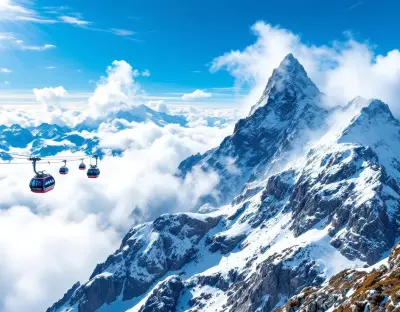
The Mount Titlis excursion from Zurich or Lucerne is an exceptional Alpine expedition at 3,020 metres. The legendary Rotair — the world's only revolving cable car — offers a 360-degree panorama of the Swiss Alps. Glacier, vertiginous suspension bridge and permanent snow await.
 Guided Tours in Switzerland
 Mount Rigi — Queen of the Mountains
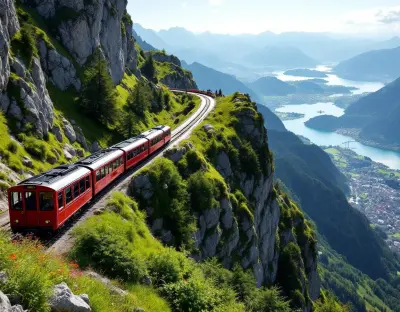
The Mount Rigi tour from Lucerne is a full day at the summit of the Queen of the Mountains. Enjoy an extraordinary 360-degree panorama, ride Europe's oldest cogwheel railway (1871) and cruise across Lake Lucerne. Also available from Zurich.